Everything filed with the RCS? If not, it can become costly
Since January 2026, Luxembourg Business Registers ("LBR") has been screening the Trade and Companies Register ("RCS") and the Register of Beneficial Owners ("RBE") automatically. Since 21 September 2026, it has been imposing sanctions: public warnings, daily penalties and strike-offs.1 2 On top of that, every late filing has carried a surcharge since March 2025.3
One month, then it gets expensive
A new manager, a new registered office, new shareholders in an S.à r.l.: changes like these must be filed with the RCS within one month.4 For the RBE, the deadline is also one month, counted from when the company knew or should have known of the change.5 Annual accounts must be filed no later than seven months after the financial year-end.4
Miss the deadline and a surcharge is added to the fee – the later the filing, the higher the surcharge:3
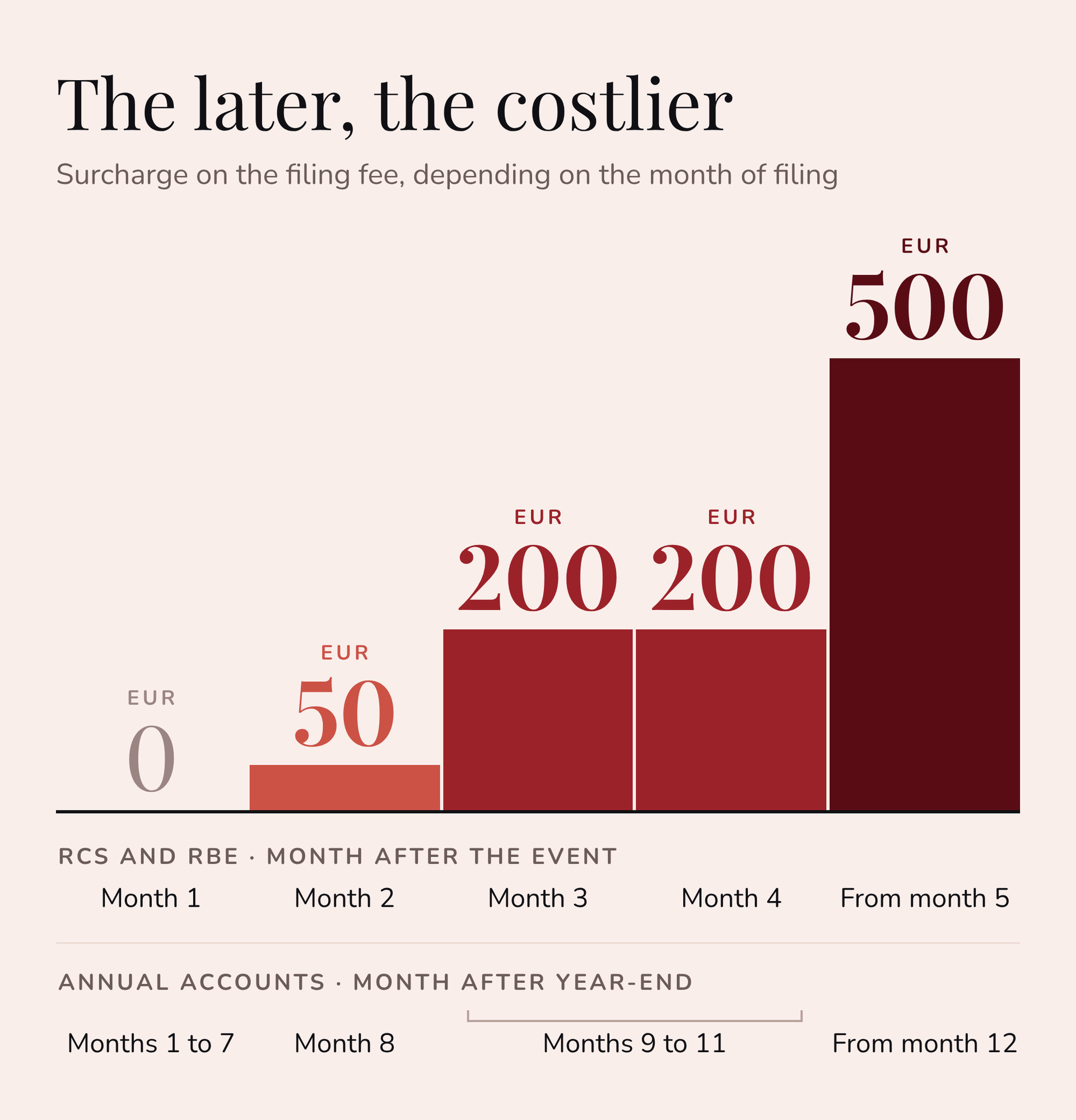
In practice: if your financial year is the calendar year and your 2025 accounts are still outstanding, the surcharge is EUR 200 in November and EUR 500 from December.
Only exception: force majeure. The regulation names no other ground on which the surcharge falls away.3
Force majeure
The regulation does not define the term. Under general civil law, it means an external event that could not be foreseen and could not be averted even with all due care, such as a natural disaster. Workload, holidays, a missing signature or a late service provider do not count as force majeure.
The timeline after the registered letter
If LBR finds missing, outdated or incorrect information, the measures escalate step by step – counted from the date the registered letter is sent, not from the event:1 6
- Registered letter
LBR writes to the registered office. From the date of sending, the company has 30 days to put things right.
- + 30 days
Warning on the publicly accessible register file.
- + 2 months
The deficiencies appear on every register extract.
- + 7 months
Daily penalty of EUR 40, capped at EUR 3,600 in total (90 days). The payment order is enforceable.
- + 12 months
Ex officio strike-off. The company continues to exist.
- Then
Referral to the State Prosecutor. Criminal offences include knowingly failing to file with the RBE or filing false information, punishable by fines on the company of EUR 1,250 to EUR 1.25m. And managers who do not submit the annual accounts to the general meeting within six months face a personal fine of up to EUR 25,000.5 6 7
Fixing the file ends the procedure at any stage. Penalties already incurred remain payable, however, and the late filing still carries the surcharge. LBR decisions can be challenged before the Administrative Tribunal within three months.1 6
The real risk for startups
A daily penalty of EUR 40 capped at EUR 3,600 in total will not sink a startup. A warning on the register in the middle of a funding round can do far more damage, because investors and banks pull a register extract for due diligence and KYC. Companies that received a letter in September and did not respond will see their deficiencies on every extract from late November.1
Three checks founders should run now:
Check the register
Are managers, registered office, shareholders and beneficial owners correct on lbr.lu, including after the last funding round? Are all annual accounts filed?
Stay reachable
Email reminders only go to an address registered with the RCS. The deadline runs from the date the registered letter is sent, and a registered office where nobody accepts mail counts as a deficiency in itself. This matters especially for startups based at an incubator or coworking space.1
Sort out identification numbers
Every individual registered with the RCS needs a Luxembourg national identification number. Founders not resident in Luxembourg should sort this out early.6
This article is for general information only and does not replace advice on individual cases.
About
Dr. Björn Bronger, MBA, is a strategic adviser to startups and lawyer, as well as lecturer in entrepreneurship at the Luxembourg School of Business (LSB).
He advises founders, investors, private clients and family offices at the intersection of strategy, finance and law. Focus areas:
- Startups & Entrepreneurs (incorporation, financing rounds, ESOP, exit)
- Corporate Governance (governing bodies, directors’ duties, shareholder relations)
- Contracts (commercially effective, legally robust)
- Immigration & Residence (market entry, residence, citizenship)

Sources
- Luxembourg Business Registers: Circular LBR 26/02 on keeping the RCS and the RBE up to date, 14 September 2026.
- Luxembourg Business Registers: Public notice on the start of the sanctions phase, 9 September 2026.
- Grand-Ducal Regulation of 13 March 2025 on the RCS and RBE fees, Mémorial A No. 106, 20 March 2025.
- Law of 19 December 2002 on the Trade and Companies Register, Art. 15 and Art. 75.
- Law of 13 January 2019 establishing a Register of Beneficial Owners, Art. 4 and Art. 20, coordinated version.
- Law of 23 January 2025 amending the RCS and RBE laws, Mémorial A No. 22, 27 January 2025.
- Luxembourg District Court, criminal judgment on Art. 1500-2 of the Law of 10 August 1915 on commercial companies, 25 June 2025.