Growth in instalments: What the EU securitisation reform means for scale-ups
Companies that sell in instalments – through instalment purchases, leasing or loans – wait a long time for their money and can easily run into liquidity shortfalls. Securitisation turns these future instalments into liquidity today – usually at a much lower cost than fresh equity. The EU now wants to make securitisation simpler and cheaper. It will only pay off above a certain size, though: a topic for scale-ups.
Securitisation is familiar from the banking world, but companies are increasingly using it too: AUTO1 has been bringing car loans to the capital market since 2024,1 the lending platform auxmoney raised EUR 950m through two securitisations within a single week in October 2025,2 and the Brussels-based leasing provider LIZY securitised its lease receivables for the first time in 2026.3
In the US, this has long been business as usual. Around 7% of all outstanding loans there are securitised, compared with only 1.9% in the EU.4 Outstanding securitisations amount to more than EUR 10,000bn in the US and around EUR 1,300bn in Europe.5 The solar provider Sunrun, for example, has placed sixteen securitisations since 2015, most recently one of USD 584m in April 2026 – backed by lease and power purchase agreements for 38,706 residential systems.6
That Europe lags so far behind is a late consequence of the financial crisis. It was triggered by securitised US subprime mortgages;4 European securitisations performed much better. Between mid-2007 and 2013, 18.4% of US credit securitisations defaulted, compared with 0.05% of European securitisations of consumer and SME loans.7 Since 2019, the EU has governed securitisation through a dedicated regulation,8 which it is now simplifying: on 21 October 2026, the Council and Parliament reached a provisional agreement on a reform.9
Securitisation in 60 seconds
A company – the originator – bundles many similar receivables, such as instalments from loans, leases, rental or long-term purchase contracts. It sells this pool to a dedicated special purpose vehicle (SPV) and receives liquidity immediately in return. The SPV finances the purchase through securities that it issues to investors in several tranches.
The payments that customers make on the securitised receivables then flow like a waterfall from top to bottom: the senior tranche is paid first, the junior tranche bears the first losses. The originator must permanently retain at least 5% of the risk itself8 – often by holding the lowest tranche, known as the junior tranche.10
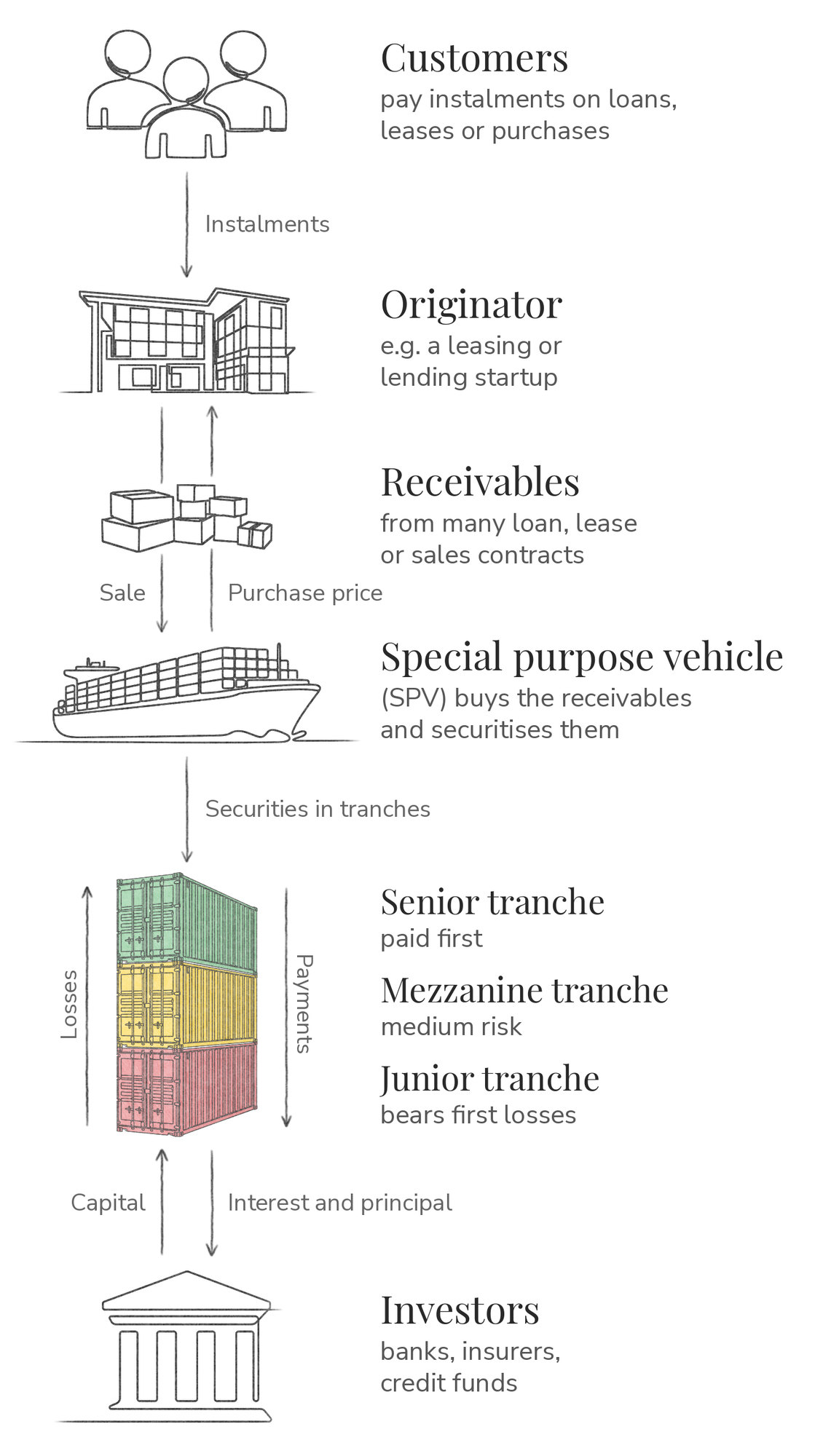
The originator receives liquidity immediately. The investors bear the default risk to differing degrees depending on their tranche – and, through the risk retention, so does the originator itself.
Why securitisation pays off – and from what size
The lever lies in the separation: investors assess the creditworthiness not of the company but of the receivables pool. The senior tranche therefore often receives a good to very good rating and carries a correspondingly low interest rate. The company usually has to put up its own capital for the lowest tranche; investors finance the rest. In its latest transaction, for example, Sunrun placed only the A tranches and retained the BB-rated Class B itself.6
This is offset by high fixed costs: structuring, the SPV, lawyers, rating agencies, trustees and ongoing reporting. They arise largely regardless of volume. Public placements therefore usually run to several hundred million euros: AUTO1 brought around EUR 223m to market in 2024,1 around EUR 249m in 202511 and around EUR 236m in July 2026.12
As a rule of thumb, securitisation rarely pays off below a volume of around EUR 100m. Smaller portfolios therefore start privately – with warehouse financing that grows with the portfolio.
Warehouse in 60 seconds
A warehouse is a securitisation under construction. New lease, rental or instalment contracts are sold on an ongoing basis to an SPV, as if into a warehouse. A bank finances this growing portfolio through a credit line – but only up to a fixed share of the receivables’ value.
The warehouse is also divided into layers: the senior tranche is typically financed by a bank, the mezzanine tranche often by a credit fund. The company bears the first loss with its own capital.10 13
Warehouses usually run for one to two years. Once the portfolio is large enough, a public securitisation replaces the warehouse (“take-out”); the financing bank often arranges it as well.10
What the reform changes
For companies, four points matter most:
- Cheaper senior financing. Banks need significantly less capital for STS senior tranches. The floor falls to 5% for “resilient” and 7% for other STS tranches;14 previously, 10% applied.15 This lowers the interest rate on the largest tranche.
- Less red tape for private deals. Private securitisations get a simpler reporting template.16 This directly benefits warehouses.
- Lighter checks for investors. Their due diligence obligations are streamlined.9 This widens the pool of potential buyers.
- More demand from funds. According to AFME, UCITS funds will in future be allowed to invest up to 25% instead of the current 10% in a single securitisation.14 17
All changes in detail
As things stand; the exact wording will follow with the final text.
Indirect
Bank capital
Risk-sensitive floors instead of fixed rates: 5% for “resilient” STS senior tranches, 7% for other STS tranches;14 previously 10% with and 15% without STS.15
For startups: cheaper senior financing, especially for established originators with STS-eligible portfolios.
Minor
New “resilient” category
Particularly robust senior positions receive the lowest capital requirements.9
For startups: the criteria are considered complex.17
Direct
Public vs private securitisations
The existing definition of “public” remains;14 private securitisations are to use a simpler reporting template.16
For startups: warehouse financings are usually private, so the reporting burden falls.
Indirect
Investor obligations
Less administrative burden;9 sanctions for inadequate due diligence are to be enforced more uniformly across the EU.14
For startups: more potential investors, faster processes.
Indirect
UCITS funds
According to AFME, the investment limit per securitisation rises to 25%;14 previously 10%.17
For startups: broader demand for public placements.
Partly
STS label opened up selectively
Cross-border transactions, insurers as protection providers and projects before commissioning are made easier.9
For startups: relevant for climate and infrastructure startups with a project pipeline and for portfolios spanning several countries.
Barely noticeable
Supervision
Stronger supervision at EU level, including of the independent STS verification agents.9
STS in 60 seconds
STS stands for “simple, transparent and standardised”. The EU label has existed since 2019. It assesses how a securitisation is structured, not the quality of the individual loans.8
Simple means a pool of homogeneous receivables, cleanly separated from the originator, with no non-performing loans and no securitisation of securitisations. Transparent means that investors receive data on the pool and a default and loss history of comparable receivables covering at least five years.8 Standardised means a fixed order of payments, hedged interest rate and currency risks and – as with every securitisation – risk retention by the originator.
The originator notifies the transaction to the EU securities regulator ESMA; third-party verification agents can confirm compliance.8 The reward: banks and other regulated investors need less capital for STS positions – and therefore accept lower interest rates.
Which startups stand to benefit
For most startups, the reform changes nothing. Software, deep-tech or biotech startups have no pool of predictable receivables – and therefore nothing to securitise.
It becomes interesting when two things come together:
- The business model generates receivables. Leasing and rental models, long-term purchase and instalment contracts – for cars, e-bikes, solar systems or heat pumps, for example – loans, buy now, pay later or revenue-based financing. Companies growing this way have to pre-finance every customer; equity is the most expensive way to do so.
- The volume is right. A securitisation of your own usually only pays off from around EUR 100m. It is therefore an instrument for scale-ups; before that, the path leads through a warehouse.
For this group, the reform makes the path cheaper: the senior tranche becomes cheaper and private structures simpler. The biggest capital advantage, however, is only available with the STS label, and that requires five years of default and loss data. Young originators have to fall back on market data for this.18 True Sale International also warned that new technical standards for granular portfolios could place an additional burden on smaller issuers.17
LIZY shows what the path can look like. Founded in 2019, the Brussels-based platform leases used cars to SMEs and the self-employed.19 As early as 2022, it raised EUR 32m in debt alongside EUR 8.5m in equity.20 Its first securitisation, a private transaction, followed in 2026.3 Together with bank loans and shareholder capital, the package totals more than EUR 300m; it is intended to lower financing costs.21
Unfortunately, the reform does nothing to reduce the complexity of securitisation. For most growth companies, it therefore remains too burdensome. But anyone growing with lease, rental or instalment contracts should make their data and contracts securitisation-ready early on. At the latest when the portfolio approaches EUR 100m, securitisation becomes the cheapest way to finance growth. The new rules make this path cheaper – they do not make it shorter.
What startups should do now
Check the business model
Does it generate predictable receivables from lease, rental, purchase or loan contracts? If not, the reform is not relevant.
Capture data from day one
Contract data, payment behaviour, defaults and losses per contract. The STS label requires a five-year history; your own data is the best basis for this.
Make contracts securitisation-ready
Receivables must be assignable, contract templates uniform and servicing properly documented.
Plan the volume
Up to around EUR 100m, the path leads through a warehouse with a bank or credit fund. The public securitisation follows once the portfolio is large enough.
Key terms explained
Originator
Originator refers to the company that generates the receivables and wants to securitise them. It sells them to the SPV and usually continues to service the customers.
Special purpose vehicle (SPV)
Special purpose vehicle (SPV) refers to a dedicated company that holds only the receivables pool. If the originator runs into difficulties, the receivables remain separate.
Tranche
Tranche refers to a slice of the financing with its own ranking. The senior tranche is paid first, the junior tranche bears the first losses and receives the highest interest rate in return.
Risk retention
Risk retention refers to the share of at least 5% of the risk that the originator must permanently retain in every securitisation – for example as 5% of each tranche (“vertical slice”) or through the lowest tranche.8 This keeps it interested in the quality of its customers.
True sale
True sale refers to the actual sale of the receivables to the SPV – the norm for companies. In a synthetic securitisation, by contrast, the loans remain on the balance sheet and only the default risk is transferred, for example through a guarantee. This is used mainly by banks.
Public securitisation
Public securitisation refers to broad placement on the capital market, usually with a rating. Private securitisations, by contrast, are negotiated directly with a few investors – typical of warehouses.
Take-out
Take-out refers to the replacement of a warehouse by a public securitisation.
ABS (asset-backed securities)
ABS (asset-backed securities) refers to securities backed by a pool of receivables – the product of a securitisation.
Legislation: what happens next
- 17 June 2025
The European Commission presents two proposals: on the Securitisation Regulation22 and on banks’ capital rules.23
- 2025 – 2026
The Council and Parliament adopt their positions and negotiate in trilogue.24
- 21 October 2026
Provisional agreement in Strasbourg.9 24 The package is a building block of the Savings and Investments Union.5
- Next
The compromise is drafted in legal language; Parliament and Council must formally adopt it.25
- Then
Publication in the Official Journal of the EU, after which the reform enters into force.25
- After that
The EU supervisory authorities develop technical standards, such as the new reporting templates.22
- From 2027
In practice, the reform is likely to take effect from 2027 at the earliest.4
Luxembourg. The Luxembourg Securitisation Law of 2004 covers far more structures and is currently being modernised (Bill No. 8761).26 However, not every Luxembourg securitisation vehicle falls under the EU rules: without tranching of the credit risk, the reform does not apply.8
This article is for general information only and does not replace advice on individual cases.
About
Dr. Björn Bronger, MBA, is a strategic adviser and lawyer, as well as lecturer in business law and entrepreneurship at the Luxembourg School of Business (LSB).
He advises startups, investors, private clients and family offices at the intersection of strategy, finance and law – in Luxembourg, Germany and internationally.

Sources
- AUTO1: Debut public market German consumer car loan ABS, 18 July 2024
- auxmoney raises close to €1 billion in debt capital markets, 9 October 2025
- Official announcement by LIZY Group NV, 26 August 2026
- EU Perspectives: Brussels bets on securitisation, 19 April 2026
- Börsen-Zeitung: EU-Verbriefungsregeln auf der Zielgeraden, 2 September 2026
- Sunrun prices $584 million securitization of residential solar and storage assets, 28 April 2026
- Bank of England and ECB: The case for a better functioning securitisation market in the European Union, May 2014
- Securitisation Regulation (EU) 2017/2402, consolidated version
- Council of the EU: Council and Parliament strike deal to revitalise the EU’s securitisation market, 21 October 2026
- Fidante (Challenger Investment Management): Securitisation warehouses, 26 June 2024
- AUTO1: Second consumer car loan ABS – FinanceHero 2, 19 September 2025
- AUTO1: Third consumer car loan ABS – FinanceHero 3, 6 July 2026
- Apollo: What Is Warehouse Lending?, 2 February 2026
- AFME welcomes EU securitisation reform agreement, 23 October 2026
- Regulation (EU) 2017/2401 amending the CRR (capital requirements for securitisations), 12 December 2017
- European Parliament, as reported by ieu-monitoring, 22 October 2026
- Börsen-Zeitung: Renaissance mit angezogener Handbremse, 16 July 2026
- European DataWarehouse: EBA guidelines on STS criteria
- Silicon Canals: Belgian car rental startup LIZY raises €11.5M, 26 February 2024
- tech.eu: Lizy wraps up €40 million financing package, 7 October 2022
- Brussels Times: Lizy leasing platform raises over €300 million, 26 August 2026
- EU Law Tracker: Securitisation Regulation (2025/0826)
- EU Law Tracker: Capital requirements for securitisations (2025/0825)
- Agence Europe: EU co-legislators seek final compromise, 21 October 2026
- European Commission: Kommission begrüßt politische Einigungen zu Emissionshandel und Verbriefungsrahmen, 22 October 2026
- Chambre des Députés: Bill No. 8761 amending the Securitisation Law of 22 March 2004, 8 June 2026